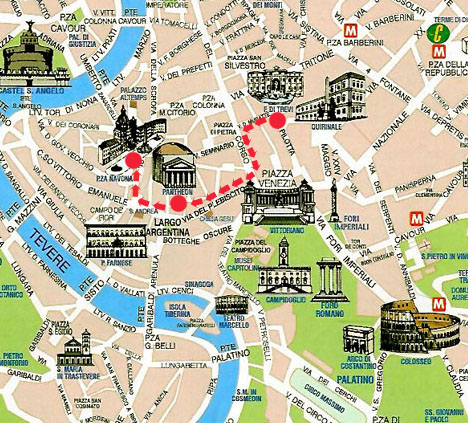

This tour includes an English-speaking guide (private - only for you)
Our guest can meet our local English-speaking guide in the meeting-point you choose.
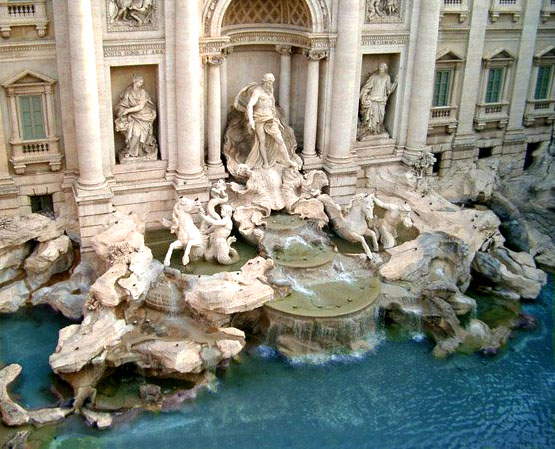
This magnificent tour of Rome will begin with the visit of the Trevi Fountain.
The Trevi Fountain is the most beautiful fountain of the city, a symbol in the world of the baroque Rome. The fountain was built for the will of Pope Clement XII and designed by Nicola Salvi, who began the work in 1733 but could not see it finished. The work was completed by Giuseppe Pannini and it was decorated by several artists of Bernini’s school and solemnly inaugurated in 1762. The fountain is the facade of a large building and it is adorned with statues and bas-reliefs placed over mighty rocks that rise from the water. The coat of arms of the Pope Clement XII, overlooking the fountain, was sculptured by Paul Benaglia and crowned by a balustrade with four statues representing the four seasons. At the centre of the fountain, there is the statue of Oceanus¸ divine personification of the sea, placed on a shell-shaped chariot pulled by winged horses. The statues in the niches represent the Abundance (on the left) and the Healthiness and they were made by the artist Filippo Valle. The bas-reliefs above it evoke the legend of the virgin indicating the sources of water to thirsty soldiers and Agrippa approving the project of the aqueduct.
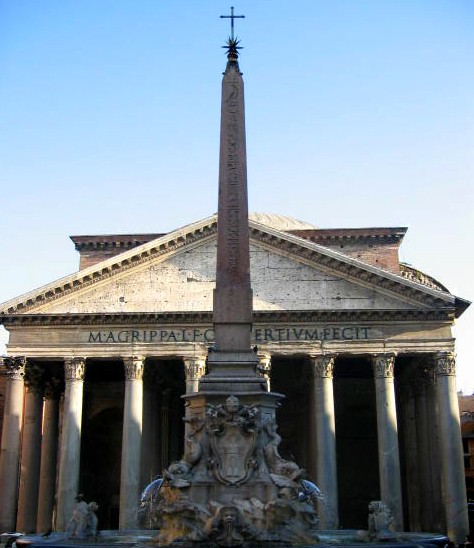
Next stop is Rome’s glory, the Pantheon which can be reached on foot.
The Pantheon is the only monument of classical architecture remained intact in Rome. The original building of Pantheon dates back to Marco Vipsanio Agrippa, son-in-law and prefect of Augustus, who, in order to celebrate the victory over the Persians, in 27 BC decided to built a temple dedicated to all the gods. This building was the Pantheon, but at that time it was not yet with the current round shape. In fact, the present form comes after a couple of fires in the temple. After the fires, the emperor Hadrian rebuilt it, between the years 118 and 125, with the appearance it has today. The inscription on the porch of the Pantheon (still visible and renewed at the end of nineteenth century by Guido Baccelli) refers to the original temple erected by Agrippa. On March 16, 609, Boniface IV changed the pagan temple into a Christian church. The porch has 16 monolithic columns of granite. The interior measures 43 meters in diameter and the same in height. Inside the Pantheon are buried some of the most distinguished artists and rulers of Italy: the remains of the painters Raffaello Sanzio (Raphael) and Annibale Carracci, the architect Baldassare Peruzzi and composer Arcangelo Corelli. A special mention should be made to the tombs of the kings of Italy : Vittorio Emanuele II and his son Umberto I with his wife Queen Margherita.
After the Pantheon’s visit, we’ll go on foot to Piazza Navona, also called Circus Agonale, because Piazza Navona square occupies the area of the Circus of Domitian, of which it retains its shape. The piazza is decorated by three marvellous fountains:
The Fountain of the Four Rivers is located in the centre of Piazza Navona (in front of the church of St. Agnes in Agony, built and designed by Borromini) and was conceived and built by the sculptor and painter Gian Lorenzo Bernini between July 1648 and June 1651 by order of Pope Innocent X, in the middle of the Baroque era, during the most fertile period of this artist.
The Fountain of the Moor is one of the oldest Renaissance fountains of Rome and was commissioned in 1574 by Pope Gregory XIII to Giacomo Della Porta.
At the north end of the square one can see the Fountain of the Coppersmiths. The fountain takes its name because of the many workshops in the area. Again, this fountain has lost some of its original statues and was completed in its sculptural decoration only in the nineteenth century.